I expect you remember that we are reading 'The Iron Man' by Ted Hughes
I expect you also remember that we had a go at making our own 'Iron Men'
Well, here they are.....
If you like what you see, why not pay someone a compliment?
Showing posts with label art. Show all posts
Showing posts with label art. Show all posts
25 January 2008

Investigating the properties of plastic - in a roundabout way!
We have been taking a closer look at plastic. We already know that there are a LOT of things that are made out of plastic. We decided to go on a plastic hunt to see what we could collect; we planned to use it in our art lesson......
By the time Thursday came around, we had a HUGE plastic sack full of goodies; and as luck would have it, for lunch that day we had yoghurt, which came in plastic pots!
First we tipped all the different plastic things onto the carpet and took a careful look at them, keeping in mind their different properties. Then we decided what we wanted to make and chose the things that had the properties we needed. Finally we set to work - with rolls and rolls of plastic sticky tape.
Look what happened when we were talking about it afterwards!
Tanmay described what he made:
This is a robot and its eyes are long. The head is made out of plastic knives and its tummy is made of a plastic milk bottle.

‘I like your robot because he has black eyes,’ said Azri.
Then Azri described what he made:
This is an animal that goes under the sea. I used a plastic knife for his hair and he has a tiny tail made from a plastic lid.

‘I like what you have used on it,’ said Per.
Then Per described what he made:
This is a parachute and it is made out of a plastic bottle and three plastic bags.

‘I like the bottom part of the parachute,’ said Justin.
Then Justin and Matthew described what they made:
This is like everybody and it’s someone that walks with hair behind him. It’s made from plastic bottles and lids and straws.

‘I like the way you made the hair,’ said Matthew.
Then Matthew and Chris described what they made:
We made a rocket and it has stands and boosters and also it has a way that they can get out. Two of the boosters are made out of plastic straws and the big booster is made out of a plastic cup and the stands are made out of plastic yoghurt pots.

‘Well I like the way you put the boosters on,’ said Rekik.
Then Rekik described what he made:
Well I put a booster there and then I put plastic knives on the rocket. It’s made out of plastic.

‘I like the way you made the booster,’ said Giulia.
Then Giulia described what she made:
I made a rocket and it is made out of plastic. It has 4 windows made out of plastic. I put some fire on it. I used the red plastic net from oranges.

‘I like the way you put the fire on it,’ said Fiona.
Then Fiona described what she made:
I made a fairy and she is mostly made out of plastic knives. Her eyes are made out of plastic straws and her wings are made out of plastic knives.

‘I like her face,’ said Isabella.
Then Isabella described what she made:
I made a boat and it’s made out of plastic. I used a plastic knife to make the paddles.

‘I like the way you used the knives,’ said Patricia.
Then Patricia described what she made:
I made this snail and it is made out of plastic ribbon for the tail and the head and I used plastic bottle tops for his shell.

‘I like the way you did the shell,’ said Evie.
Then Evie described what she made:
I made a rocket and it has a yellow window made out of a plastic lid and the plastic boosters have fire made from three plastic straws.
‘I like the way you made the boosters,’ said Danah.
Then Danah described what she made:
This is a puppet girl and she’s mostly made out of plastic. Her hair is made out of a plastic label and her tee-shirt and skirt is made out of a plastic bag.

‘I like the way that you made her hair,’ said Sofia.
Then Sofia described what she made:
This is a flute. It’s made of plastic straws. I asked Danah to give me a piece.

‘I like how you made the bits for your fingers,’ said Maya.
Then Maya described what she made:
This is a crocodile and I made it and first I took this plastic grape box and then I put this plastic yellow straw and then I attached it to a parachute.

‘I like how you did the body,’ said Michelle.
Then Michelle described what she made:
This is a girl and it is made out of plastic and her hair is made of plastic ribbon.

‘I like the way you made it,’ said Swati.
Then Swati described what she made:
I made this and the first thing that I did, I put a plastic yoghurt bottle over here and then I put a plastic straw inside it and then I put sellotape over it.

‘I like the bottle,’ said Naoya.
Then Naoya described what he made:
This is a rocket. I made it out of a plastic yoghurt bottle.

‘I like your rocket,’ said Umar.
Then Umar described what he made:
I made a rocket with fire down here. I made it with plastic bottles and a very long pointy part.

‘I like your rocket,’ said Vaishnavi.
Then Vaishnavi described what she made:
This is a telephone. This is made out of plastic. I used plastic knives and plastic bottles and plastic straws and a plastic label.

‘I saw the same pictures in a cartoon and I laughed and laughed. I like your telephone,’ said Tanmay.
Then Tanmay described what he made:
This is a robot and its eyes are long. The head is made out of plastic knives and its tummy is made of a plastic milk bottle..........
By the time Thursday came around, we had a HUGE plastic sack full of goodies; and as luck would have it, for lunch that day we had yoghurt, which came in plastic pots!
First we tipped all the different plastic things onto the carpet and took a careful look at them, keeping in mind their different properties. Then we decided what we wanted to make and chose the things that had the properties we needed. Finally we set to work - with rolls and rolls of plastic sticky tape.
Look what happened when we were talking about it afterwards!
Tanmay described what he made:
This is a robot and its eyes are long. The head is made out of plastic knives and its tummy is made of a plastic milk bottle.
‘I like your robot because he has black eyes,’ said Azri.
Then Azri described what he made:
This is an animal that goes under the sea. I used a plastic knife for his hair and he has a tiny tail made from a plastic lid.
‘I like what you have used on it,’ said Per.
Then Per described what he made:
This is a parachute and it is made out of a plastic bottle and three plastic bags.
‘I like the bottom part of the parachute,’ said Justin.
Then Justin and Matthew described what they made:
This is like everybody and it’s someone that walks with hair behind him. It’s made from plastic bottles and lids and straws.
‘I like the way you made the hair,’ said Matthew.
Then Matthew and Chris described what they made:
We made a rocket and it has stands and boosters and also it has a way that they can get out. Two of the boosters are made out of plastic straws and the big booster is made out of a plastic cup and the stands are made out of plastic yoghurt pots.
‘Well I like the way you put the boosters on,’ said Rekik.
Then Rekik described what he made:
Well I put a booster there and then I put plastic knives on the rocket. It’s made out of plastic.
‘I like the way you made the booster,’ said Giulia.
Then Giulia described what she made:
I made a rocket and it is made out of plastic. It has 4 windows made out of plastic. I put some fire on it. I used the red plastic net from oranges.
‘I like the way you put the fire on it,’ said Fiona.
Then Fiona described what she made:
I made a fairy and she is mostly made out of plastic knives. Her eyes are made out of plastic straws and her wings are made out of plastic knives.
‘I like her face,’ said Isabella.
Then Isabella described what she made:
I made a boat and it’s made out of plastic. I used a plastic knife to make the paddles.
‘I like the way you used the knives,’ said Patricia.
Then Patricia described what she made:
I made this snail and it is made out of plastic ribbon for the tail and the head and I used plastic bottle tops for his shell.
‘I like the way you did the shell,’ said Evie.
Then Evie described what she made:
I made a rocket and it has a yellow window made out of a plastic lid and the plastic boosters have fire made from three plastic straws.
‘I like the way you made the boosters,’ said Danah.
Then Danah described what she made:
This is a puppet girl and she’s mostly made out of plastic. Her hair is made out of a plastic label and her tee-shirt and skirt is made out of a plastic bag.
‘I like the way that you made her hair,’ said Sofia.
Then Sofia described what she made:
This is a flute. It’s made of plastic straws. I asked Danah to give me a piece.
‘I like how you made the bits for your fingers,’ said Maya.
Then Maya described what she made:
This is a crocodile and I made it and first I took this plastic grape box and then I put this plastic yellow straw and then I attached it to a parachute.
‘I like how you did the body,’ said Michelle.
Then Michelle described what she made:
This is a girl and it is made out of plastic and her hair is made of plastic ribbon.
‘I like the way you made it,’ said Swati.
Then Swati described what she made:
I made this and the first thing that I did, I put a plastic yoghurt bottle over here and then I put a plastic straw inside it and then I put sellotape over it.
‘I like the bottle,’ said Naoya.
Then Naoya described what he made:
This is a rocket. I made it out of a plastic yoghurt bottle.
‘I like your rocket,’ said Umar.
Then Umar described what he made:
I made a rocket with fire down here. I made it with plastic bottles and a very long pointy part.
‘I like your rocket,’ said Vaishnavi.
Then Vaishnavi described what she made:
This is a telephone. This is made out of plastic. I used plastic knives and plastic bottles and plastic straws and a plastic label.
‘I saw the same pictures in a cartoon and I laughed and laughed. I like your telephone,’ said Tanmay.
Then Tanmay described what he made:
This is a robot and its eyes are long. The head is made out of plastic knives and its tummy is made of a plastic milk bottle..........
17 January 2008
The Iron Man
We have begun reading 'The Iron Man' by Ted Hughes
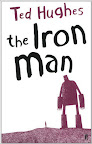
The Iron Man fell off the cliff and broke into pieces. However, he was able to put himself together again; apart from his ear, which had been found by seagulls and put in their nest. We think he was looking for his missing ear when he walked down, down, down into the sea again and disappeared, with his eyes flashing.
In today's episode, the Iron Man came back. Hogarth spotted him back on the edge of the cliff when he was doing some fishing. Of course he was scared and he ran back home. He told his father what he had seen.
Now, if you told your father that you had seen an Iron Man as big as a house with feet the size of a single bed, what would he have said? But Hogarth's father believed him! He believed him because he had seen the evidence.....
The evidence was a tractor in the yard that had been BITTEN in half! There were teeth marks to prove it. There was other evidence too; chewed up diggers and bulldozers, a half-eaten bicycle wheel and a piece of a mud-guard.
All the farmers from round about decided to make a trap for the Iron Man. And this is what they did.....They dug a huge hole, as deep as three trees with steep sides. They covered it with branches and straw and then earth, so that it looked just like a ploughed field. On the far side of the trap they placed the bait. This was a rusty (but tasty looking) lorry. They hoped the Iron Man would be tricked and fall into the trap on his way to eat the bait, but so far, he has not reappeared.....and we have to wait for the next exciting episode to find out what happens next.
But in the meantime, we got thinking about the things that the Iron Man might have enjoyed for his supper. We know that he likes things made from IRON and STEEL (which are both metal).
In art we made our own Iron Man. We sketched him on paper first. Then we looked at the different shapes we had drawn; we saw squares, rectangles, semi-circles. We cut out the shapes we wanted to use for the body parts from metal foil and used other metal things for his eyes, ears and hands. We used paper clips, thumb tacks and staples and we even provided him with tasty metal snacks, in case he got hungry. But the best fun of all was searching through Momo's bucket of screws, nails and rivets to see what else we could find that might be useful.......................
Take a look at the process in our slide-show.
11 January 2008
Meet the Wooden Tops!
What is it like? - Wood
First we collected different examples of wood products; we found toothpicks, match-sticks and sawdust. What other things did we find?
We looked carefully at the properties of the things in our collection so that we could choose what would be best to make our faces.
We found things that were:
Rigid Brittle Hard Flexible Shiny Dull Soft Rough Smooth
Most of us used flexible cane to make the shape of the face. Some of us used lolly-sticks to make the eyes. Some people made eyebrows from pencil sharpenings. What have we used for the hair?
What would you have used? Why?
29 November 2007
Spirograph patterns
We had a look at some amazing patterns a little like the one you see below.
Created by Anu
Garg.
Created by Anu
Garg.
Ours were made using a machine called a ‘Spirograph’.
Some of our parents made the same kinds of patterns when they were young!
Patricia noticed that the name 'Spirograph' sounded a bit like the word spiral. That got us thinking and we all watched carefully as a ‘Spirograph’ pattern was made using the machine. As we watched we saw the pencil moving round in a curved, spiral shape.
We had a go at making our own but we made them in a different way.
How do you think we did ours? Look carefully.
Can you work it out?
You should be able to see one shape repeated lots of times
What shapes do you see?
27 November 2007
Weaving; in and out and in and out...
We were lucky enough to have a visit on Friday from Wendy, Joe's mum. She and Joe had been practising weaving 'Gods' Eyes' with wool and thought that we might be able to make some of our own.

Gods' Eyes are made using a frame of two crossed sticks. Coloured wool is wound around the frame to make a design called "Ojo de Dios" or "Eye of God".
It is thought they originated in Mexico; there, when a child is born the father weaves the central part of the eye. Then each year, another colour is added until the child is five years old.
We started ours with a black centre. Then we chose two different colours of wool so that we could weave the rest in a repeating abab pattern.
If you decide to make one of your own, you can hang it up as a decoration. We have used ours to decorate the classroom!
09 November 2007
Diwali - and some new patterns
This year, November 9th, is the festival of Diwali. It is the most widely celebrated festival in India. Not only Hindus observe Diwali but also Buddhists, Jains and Sikhs.
To help us learn more about this special occasion, we were lucky enough to have a visit from Tanmay's mother. She first told us the story of how Prince Rama and his wife Sita were sent away from their home and how they had to go and live in the forest, along with Rama's brother Lakshmana. After 14 happy years there, Sita was kidnapped by the ten-headed demon Ravana, but she was eventually rescued by Rama, with the help of Hanuman, the monkey warrior. 'Divas' (oil lamps) helped guide Rama and Sita back from the forest to their home in Ayodhya. When they arrived, Rama was crowned as king.
Diwali symbolises the victory of good over evil; it means 'festival of lights'. On this day people light tiny candles or divas to fill their homes with bright light as a sign of celebration.
They also create lovely designs all around their home with colorful 'rangoli' art. Rangloi are traditional Indian geometrical patterns used to ward off evil spirits. They are usually painted on walls or the ground outside the house. Hindus hope that Lakshmi, the goddess of good fortune, will see the beautiful patterns and come into their homes.
After the story, we had a go at making our own Rangoli patterns. We used coloured rice to make symmetrical geometric patterns.
08 November 2007
Pass it on.....
Do you want to know how to play the game 'Pass it on'?
First, get together with about five or six friends. Then think of a shape or symbol that you can paint over and over again. Next choose the colour you would like to paint your shape. Then collect a long narrow strip of paper.
Now, paint your chosen shape onto one end of the paper (your friends will all be doing the same as you, but with their own choice of shape and colour). When everyone has finished, you all say 'Pass it on' as you pass your paper to the left.
You then have to paint the same shape on your neighbour's paper, right next to their shape and again you 'Pass it on' when everyone is ready. You should keep on going until the strip of paper is full of different coloured shapes and symbols; just paint your shape and 'Pass it on'.
When you have finished, see if you can spot any patterns. How many different symbols do you see? Are there the same number of different shapes as the number of people who played the game with you? Do all the strips look the same? If not, why do you think this is? How can you line up the strips so the pattern continues?
Here are some 'Pass it on' patterns that we made this afternoon.
Could you think of another way to play 'Pass it on'? Why not try it out with your friends?
01 November 2007
Spinning around.....in art

We noticed that spiral shapes are all around us:
Sunflower seeds grow in a spiral shape
Snail shells grow in a spiral shape
Sometimes the weather makes a spiral shape, like hurricanes.
Some fossils are spiral-shapedSunflower seeds grow in a spiral shape
Snail shells grow in a spiral shape
Sometimes the weather makes a spiral shape, like hurricanes.
What other things have a spiral shape?
Click on the link to find out.This is how we made our own:
We chose red or black or white paper.
We had red, black and white paint.
We found interesting things to dip into the paint to make our spirals, like unifix cubes, clothes pegs, the 'wrong' end of the paint brush.
01 October 2007
22 September 2007
After Arcimboldo
Mira has been doing a course using nature for some really cool activities; we decided to try out one of them today - to great effect! Children worked in 3 groups, each choosing someone to lie down on the ground. The rest of the group then hunted for sticks to make an outline of the body. Then, with the body out of the way, they filled the outline with different parts of plants: leaves, petals, seeds and so on.
With bad weather predicted for the early part of the week, our Arcimboldo-inspired natural art will probably be scattered (quite literally) to the four winds. Luckily we made a photographic record for you to enjoy.
15 September 2007
Art Soup
To make ART SOUP, all you need is a classroom full of enthusiastic six and seven year-olds and a basket of different vegetables.
First use your choice of sliced vegetables to make a face. Admire it, change the expression, clamour to have it photographed. It is OK to taste as you work! (Click on each child's blog to see the picture they made).
Next, wash the vegetables (after all that tasting!) taking care to remove any that might be more suitable for a salad (in our case radishes and cucumber).
Put the vegetables into two huge saucepans, each with a litre of water and two child-sized pinches of salt.
Set to simmer in the staff-room kitchen.
When the delicious smell of cooking wafts all the way along the corridor and up the stairs to Class 2i, it is probably ready.
Bring the saucepan into the classroom and blend the soup with the help of 'Brenda-the-Blender'. It is essential that everyone has a turn at using the blender - but do make sure that, however exciting it is, before the motor is switched on, the head (of the blender!) is submerged.....the teacher can only stand being splattered with near-boiling soup so often!
Once the soup is smooth, serve.
Delicious ART SOUP. Thoroughly recommended.
Here's the story:
Umar said, “Mira cut up all the vegetables.”
Max said, “We did not put the radishes in the soup.”
Fiona said, “ We put the radishes and cucumber together to make a salad.”
Dangi said, “ We had potatoes. We added salt and water to make the soup.”
There were other vegetables in the soup as well. There were carrots, cauliflower and celery. 18 children said that the tomatoes went into the soup but 6 said that they did not.
Tanmay told us that 2i went to the staff room to cook it.
After the cooking Per said we put the ART SOUP in a machine to mix it.
Some people ate the ART SOUP. Patricia did not.
Everyone in Class 2i helped to make the ART SOUP.
Edible Art

As part of their Unit of Inquiry into "How we share the planet", Our World of Plants, students in Class 2i created pictures out of fruits and vegetables. Read about their work on each student's blog.
Before the start of this lesson, children were invited to try and guess what they would be doing in art. They were given some clues; that they would not use pencils, paint or crayons; that there would be no need for paper, scissors or glue; that they might even get to nibble their work along the way....
I love the creative way in which everyone used the different vegetables and fruits. Who would have imagined fennel slices for a smiley mouth or celery leaves for hair? And who would have imagined what we would get to eat the following day for our lunch? Click on the link to ART SOUP......
Subscribe to:
Posts (Atom)


